Vacuum system simulation: pumping speed, pumpdown, base pressure and molecular flow
Build a system from real vacuum parts: seal every port then simulate it. Pick one simulation or several at once: results come back in about a second, in a report you can save and share. For the last word on a design, the full assembly molecular flow simulation traces millions of molecules through the whole system on our compute servers.
Effective pumping speed
The pumping speed you actually get at your chamber after every tee, reducer and nipple in the line.
Effective speed, conductance of each part, and a 3D speed map.
Pumpdown curve
Pressure versus time from atmosphere, with your backing pump, turbo run-up, leaks and outgassing.
Time to each pressure, and what limits the final pressure.
Steady-state UHV
The base pressure in every part once the system settles, from unbaked to a 300 °C bake.
A 3D pressure map, a bakeout slider, and what sets your base pressure.
Full assembly molecular flowPro
Every part's gas volume is joined into one and traced as a single Monte Carlo run, the way Molflow does it, so gas beaming straight through crosses and nipples is captured instead of estimated part by part.
- Choose from 100,000 to 5 million molecules. Run time and precision shown before you start
- Steady-state pressure as a 3D map, with every part outgassing by its material, unbaked or baked, plus a leak
- Effective pumping speed at your chamber with its uncertainty, and the local pumping speed each part sees
- Where the conductance limits you: the throughput, pressure step and conductance of every connection, the highest-pressure spots, and what each pump takes
- Runs on our compute servers: queue it, close the window, and the full report lands in your Reports
A pressure map of every wall, effective pumping speed, connection-by-connection conductance, and a detailed report.
Questions
How accurate are the simulations?
Every part is characterized from its full 3D geometry when it joins the catalog, rather than approximated with textbook tube formulas, so crosses, tees, reducers and chambers are captured as they're actually shaped. System results are checked against standard analytic cases.
How fast is it?
Pumping speed, pumpdown and steady-state solve in about a second, so you can swap a part, change a pump or try another material and re-run as often as you like. A full assembly molecular flow run takes from under a minute for 100,000 molecules to around half an hour for 5 million on a long, narrow line, and you can run all of them together.
What is the full assembly molecular flow simulation?
A test-particle Monte Carlo of the whole assembled system. Every part's gas volume is placed where it sits, molecules are released from every wall in proportion to its outgassing, and each one is followed bounce by bounce until a pump captures it. Counting where they hit gives the steady-state pressure at thousands of spots over the walls, the effective pumping speed at your chamber, and the throughput and conductance of every connection, so you can see exactly where gas collects and which section to widen. It's part of Pro.
How many molecules do I need?
100,000 is enough to see where pressure builds up and what limits your pumping, with the pumping speed within about 1%. Use 1 million or more for a smooth pressure map and figures to quote; 5 million brings the pumping speed to about 0.1%. The set-up shows the expected run time and precision for your system before you queue it.
What does the steady-state simulation include?
Water and hydrogen outgassing from every wetted surface by material, a leak rate, and the pump's own ultimate pressure, for bakeouts from none up to 300 °C. No part is baked above its material's limit, such as 150 °C for Viton.
What does the pumpdown simulation include?
Pressure versus time from atmosphere to base pressure: your backing pump, the turbo pump's speed and run-up, a leak rate, and outgassing from every wetted surface by material, unbaked or baked.
Which gases are supported?
Nitrogen, hydrogen, helium, argon, water vapor and air, using the pump's datasheet speed for each gas where available.
What do I get out of it?
Effective pumping speed with a 3D speed map and per-part conductance; a pumpdown curve with the time to each pressure; the base pressure in every part across bakeout temperatures; and, with the full assembly simulation, a pressure map of every wall, the conductance of each connection and the highest-pressure spots. Every simulation comes with a full HTML report including the bill of materials and flange hardware.
Start from a part
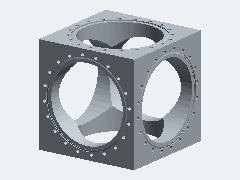 CF 8.0″ 6-port box chamberCF 8.0″ · 6,105 cm³
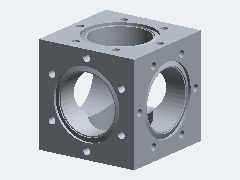 CF 2.75″ 6-port chamberCF 2.75″ · 172 cm³
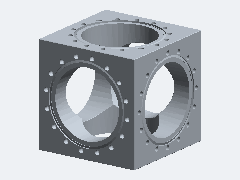 CF 6.0″ 6-port multiport chamberCF 6.0″ · 2,224 cm³
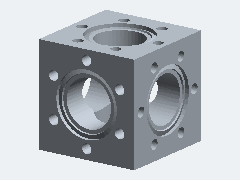 CF 1.33″ 6-port box chamberCF 1.33″ · 15 cm³
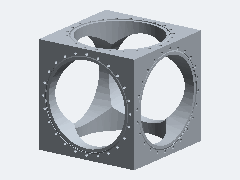 CF 10.0″ 6-port box chamberCF 10.0″ · 12,884 cm³
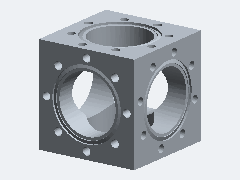 CF 3.375″ 6-port box chamberCF 3.375″ · 342 cm³
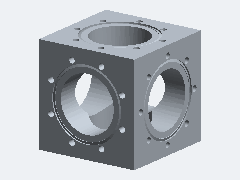 CF 4.5″ 6-port box chamberCF 4.5″ · 737 cm³
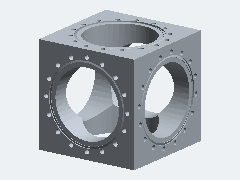 CF 6.0″ 6-port box chamberCF 6.0″ · 2,243 cm³
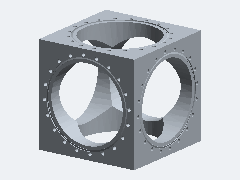 CF 8.0″ 6-port box chamberCF 8.0″ · 6,143 cm³
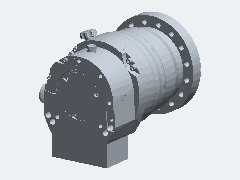 Pfeiffer HiPace 300H turbomolecular pump (CF 6.0″)CF 6.0″ · 260 L/s N₂
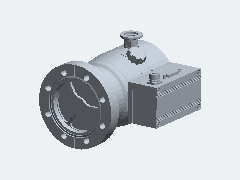 Pfeiffer HiPace 80 turbomolecular pump (CF 4.5″)CF 4.5″ · 67 L/s N₂